










Candles Are Evidence, Not Commands
Candlestick patterns are often presented as simple buy or sell signals, but that is not how they should be used. A candle is a record of market pressure during a period. It shows where price opened, where it traded, where it was rejected, and where it closed.
The same candlestick can mean different things depending on location. A rejection candle at major support carries more information than a similar candle in the middle of a range. Context decides whether the candle matters.

Applied Market Scenario
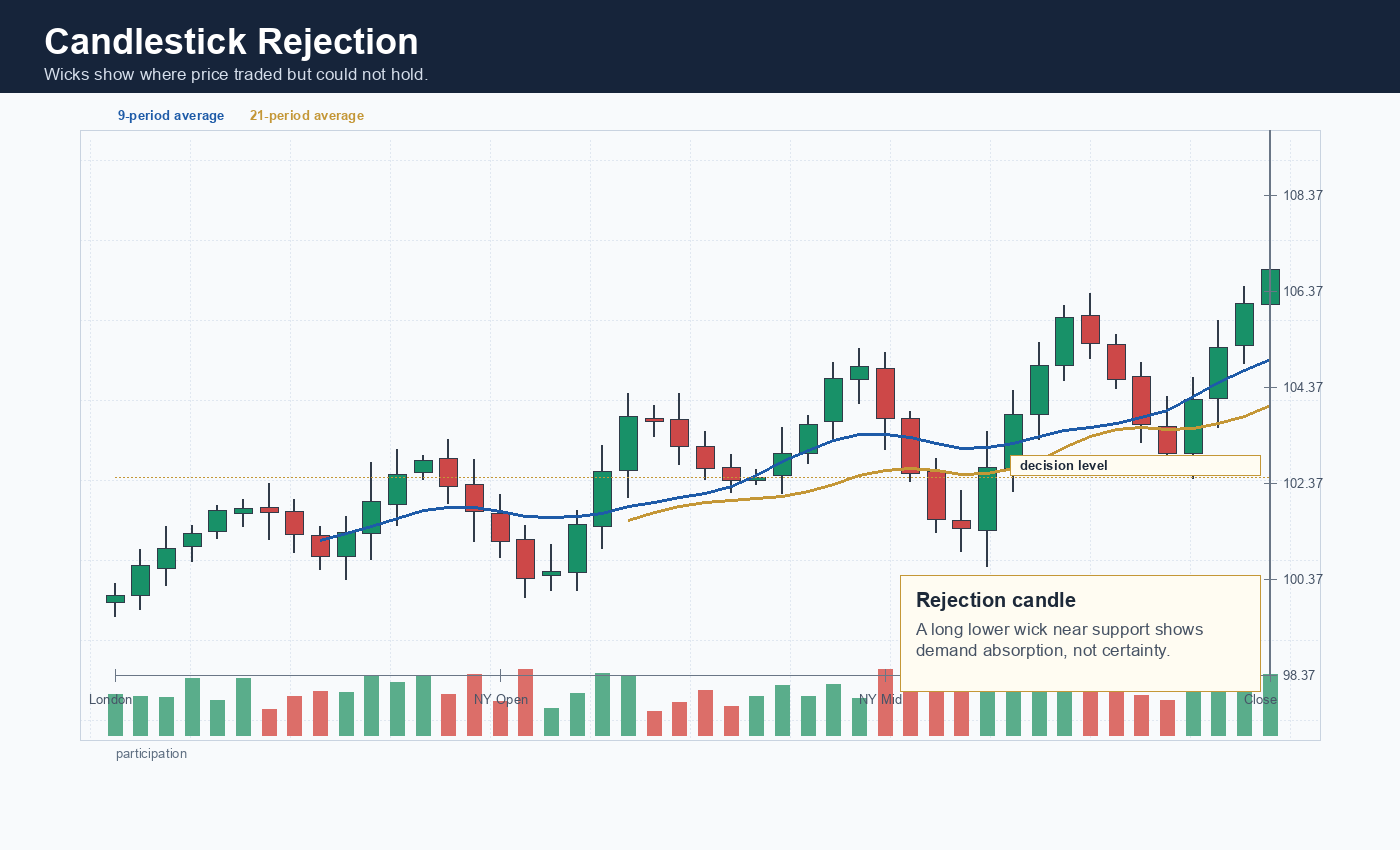
Assume XAUUSD pulls into a support zone and prints a long lower wick. The information is that sellers could not hold lower prices during that candle. A professional process then asks whether the next candles confirm demand, whether volatility supports the stop, and whether the target justifies the risk.
Candlestick Checklist
- Read the market structure before the candle pattern.
- Prioritise candles that form at important levels.
- Use the close, not only the wick, to assess acceptance.
- Define invalidation beyond the candle or structure.
- Avoid treating a single candle as a complete strategy.
Reading The Auction Inside The Candle
Each candle is a compact record of auction behaviour. The open shows where the period started, the high and low show the range of negotiation, and the close shows where the market accepted value when the period ended. Long wicks show rejection. Strong closes near the high or low show directional control.
A long lower wick on XAUUSD after a sell-off may indicate that demand appeared below the market. That is useful information, but it is not complete on its own. The next question is whether subsequent candles hold above the wick area, whether the level has higher-timeframe relevance, and whether the stop distance is reasonable for current volatility.
Combining Candles With Structure
Candlestick work is strongest when combined with support, resistance, trend and volatility. A rejection candle at a rising higher low is more meaningful than the same candle in an undefined range. A bearish engulfing candle at weekly resistance has more value than one printed after price has already fallen into support.
Daily Implementation Framework
Candlestick Patterns That Actually Matter In Forex should be applied as part of a structured market routine. The process begins before execution: define the higher-timeframe condition, identify the key levels, assess volatility, then decide whether the current session offers enough liquidity and range to justify risk. This prevents the analysis from becoming reactive after price has already moved.
During execution, the trade plan should be written in clear terms: entry condition, invalidation point, target area, risk per trade and reason for taking the position. A trade that cannot be explained in those terms is usually not ready for capital. The strongest trading decisions tend to be simple, documented and repeatable.
- Pre-session: mark structure, major levels, news risk and expected volatility.
- Trade selection: require alignment between market condition, setup quality and risk-reward.
- Execution: size the position from the stop distance rather than from confidence.
- Management: reduce or exit when the original thesis is no longer valid.
- Review: record whether the trade followed the process, not only whether it made money.
Review And Improvement
The value of any education framework is measured by how well it improves selection and discipline over time. After a series of trades, review which conditions produced the best outcomes, which symbols created unnecessary volatility, and whether losses came from analysis, timing, sizing or execution. The goal is not to predict every move. The goal is to build a process that survives uncertainty and allocates risk only when the evidence is strong enough.
This material is provided for education and market understanding only. It is not personal investment advice, a recommendation to trade, or a guarantee of future performance.