










Volatility Defines The Trading Environment
Volatility measures how much price normally moves. It affects stop placement, target selection, trade duration and position size. A setup that works in a calm EURUSD session may behave very differently in XAUUSD during a high-volatility news window.
Professional volatility trading starts by recognising the instrument profile. Gold, EURUSD and JPY pairs do not move the same way, and the risk framework should reflect those differences.

Applied Market Scenario
Assume a trader uses the same 20-pip stop on EURUSD and XAUUSD. That is not a volatility-aware process. Gold may move the equivalent of that distance through normal fluctuation. A more professional approach uses ATR and recent range to determine whether the stop is technically meaningful.
Volatility Checklist
- Check ATR before selecting stop distance.
- Compare current volatility with the recent average.
- Reduce position size when stop distance must widen.
- Avoid using the same parameters across all symbols.
- Treat news windows and spread expansion as risk events.
- Review whether strategy performance changes by volatility regime.
Volatility Changes The Meaning Of Distance
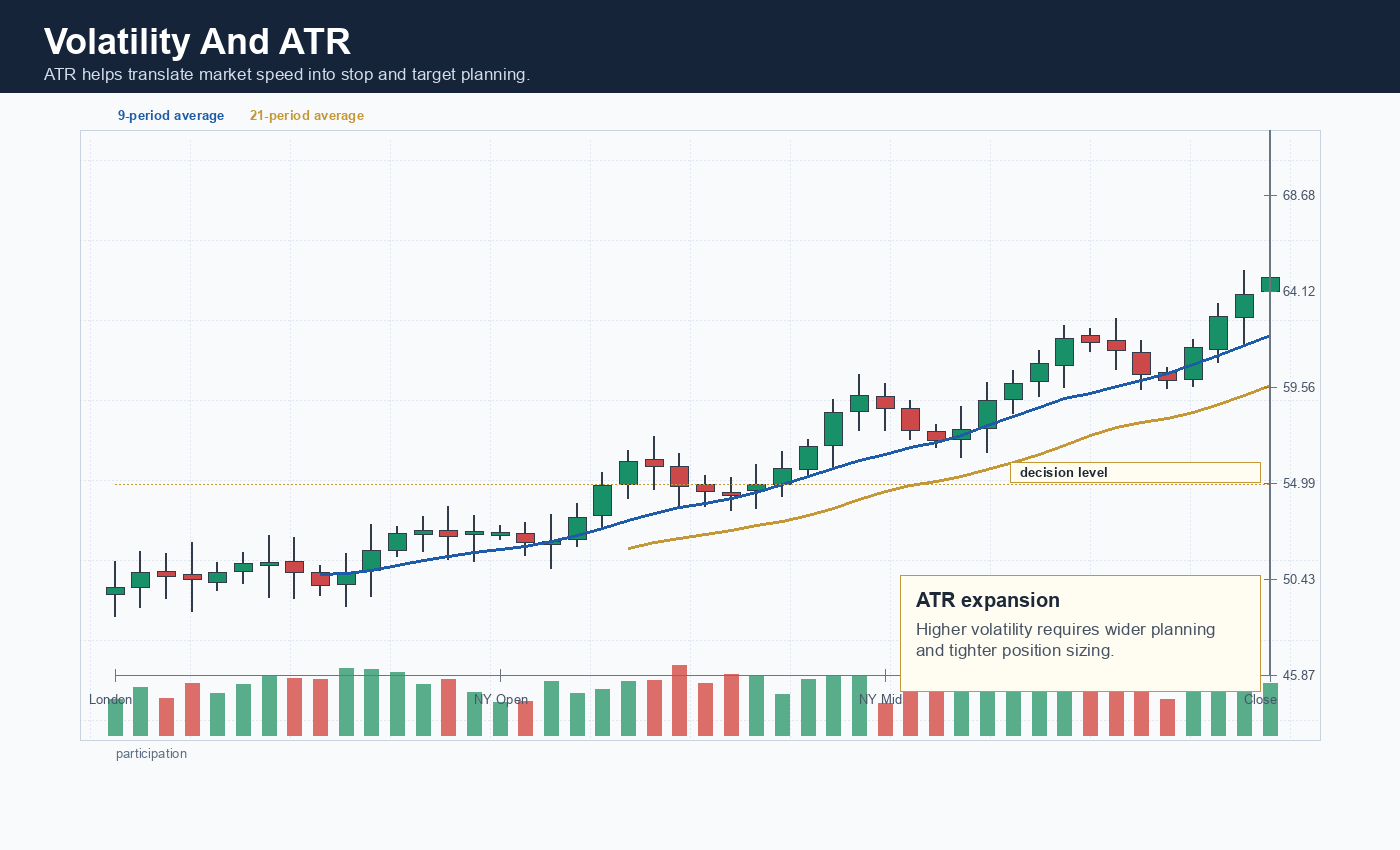
A 20-pip move does not mean the same thing in every instrument or every market condition. On a quiet EURUSD session, it may be meaningful. On XAUUSD during a high-volatility window, an equivalent distance may be ordinary noise. Volatility gives context to stops, targets and expected holding time.
ATR helps translate that context into planning. If ATR is expanding, stops may need to be wider and size smaller. If ATR is compressed, breakout trades may need patience because false starts are common before genuine expansion. The same technical setup can require different risk treatment under different volatility regimes.
Symbol-Specific Planning
Gold often demands wider technical allowances, while major FX pairs may provide tighter spreads and deeper liquidity. JPY pairs can be sensitive to rates and risk sentiment. GBP pairs may move sharply around UK data and liquidity transitions. A professional model respects these differences rather than applying one parameter set to every market.
Daily Implementation Framework
Volatility Trading: Why Gold, EURUSD, And JPY Pairs Behave Differently should be applied as part of a structured market routine. The process begins before execution: define the higher-timeframe condition, identify the key levels, assess volatility, then decide whether the current session offers enough liquidity and range to justify risk. This prevents the analysis from becoming reactive after price has already moved.
During execution, the trade plan should be written in clear terms: entry condition, invalidation point, target area, risk per trade and reason for taking the position. A trade that cannot be explained in those terms is usually not ready for capital. The strongest trading decisions tend to be simple, documented and repeatable.
- Pre-session: mark structure, major levels, news risk and expected volatility.
- Trade selection: require alignment between market condition, setup quality and risk-reward.
- Execution: size the position from the stop distance rather than from confidence.
- Management: reduce or exit when the original thesis is no longer valid.
- Review: record whether the trade followed the process, not only whether it made money.
Review And Improvement
The value of any education framework is measured by how well it improves selection and discipline over time. After a series of trades, review which conditions produced the best outcomes, which symbols created unnecessary volatility, and whether losses came from analysis, timing, sizing or execution. The goal is not to predict every move. The goal is to build a process that survives uncertainty and allocates risk only when the evidence is strong enough.
This material is provided for education and market understanding only. It is not personal investment advice, a recommendation to trade, or a guarantee of future performance.