










S&P Global PMIs are expected to indicate business activity in the US continued to expand in February.
…
This is a premium post.
[s2If !current_user_can(access_s2member_level4)]Please register for FREE REGISTER to read full post below containing analysis. In case of any error or you think you are not able to read the full post below, please email us at support#nehcap.com [lwa][/s2If] [s2If current_user_can(access_s2member_level1)]
- S&P Global PMIs are expected to indicate business activity in the US continued to expand in February.
- Manufacturing and Services output seen advancing at a moderate pace.
- EUR/USD stuck around 1.0800, signs of buyers losing interest.
S&P Global will release the flash estimates of the United States (US) Purchasing Managers Indexes (PMIs) on Thursday, a survey that measures business activity throughout the month. The report is divided into services and manufacturing output and compiled in a final figure, the Composite PMI.
The economic activity in the US private sector expanded at a modest pace in January, with the S&P Global Composite PMI reaching 52.0, following a bounce in manufacturing output to 50.7. At the same time, the services index reached 52.5.
Manufacturing has been lagging behind, although the latest reading has been quite encouraging, as it showed improvement in the sector’s health for the first time since April 2023. The official report notes: “Overall growth was supported by a return to expansion in new orders and a slower contraction in output. Production was reportedly hampered, however, by a renewed decline in supplier performance and longer input deliveries. Greater transportation costs pushed input prices higher on the month, with cost inflation hitting a nine-month high. In response, firms hiked their selling prices at the fastest rate since April 2023.”
The US economy is in expansion mode, which means the country will likely dodge a recession and even a soft landing. But this could come at the cost of higher inflation, which may prompt the Federal Reserve (Fed) into additional tightening. In such a case, higher rates will increase the risk of an economic setback.
The US Fed paused monetary tightening in the last quarter of 2023, and market participants rushed to price in upcoming rate cuts. The odds centered in March as policymakers continued to deliver the “higher-for-longer” message. However, the late January Fed monetary policy meeting and hotter-than-anticipated inflation in January convinced investors that policymakers won’t rush into loosening the monetary policy. At the time being, the first rate cut is more likely to take place in June.
The February S&P Global Manufacturing PMI is foreseen at 50.5, ticking modestly lower from the previous 50.7, although holding within expansionary levels. The same situation is expected around services output, as the index is expected at 52.0, easing from 52.5 in January.
As long as the readings remain above 50.0, the impact of a decline should be limited. However, a slump below the line that separates expansion and contraction could revive speculation of a Fed rate cut amid renewed recession-related concerns. That could spur optimism for risk assets and weigh on the US Dollar.
On the contrary, stronger-than-anticipated figures will give the Fed more time to hold rates unchanged and assess more data before deciding on a monetary policy change.
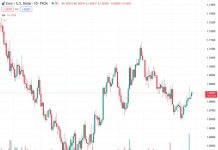
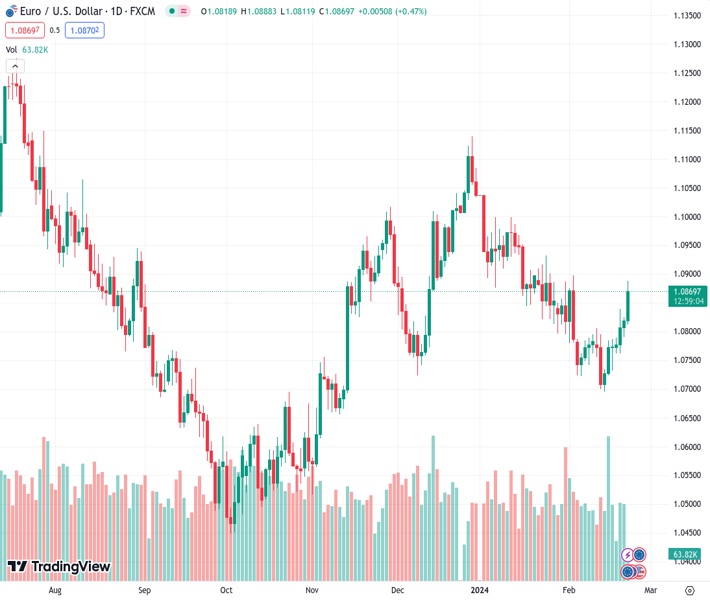
The S&P Global PMI report will be released this Thursday at 14:45 GMT. Ahead of the event, the US Dollar has been trimming panic-related gains, with EUR/USD currently trading at around 1.0800. The pair collapsed to 1.0694 in mid-February following the release of the January US Consumer Price Index (CPI), which surpassed market expectations, but as market players assumed that a Fed’s rate cut would be more likely for June, the sentiment began improving.
Tepid European data, however, has limited the bullish potential of the Euro, which anyway advanced against its American rival.
Valeria Bednarik, Chief Analyst at FXStreet, said: “The EUR/USD pair has reached a three-week peak at 1.0839, but it is clear that selling around the 1.0800 level is strong, as gains beyond it have been quickly reverted in the last two weeks. Market players are waiting for a solid catalyst that the market is failing to provide.” Furthermore, she adds: “The ongoing recovery seems corrective. EUR/USD hovers around the 23.6% Fibonacci retracement of the 1.1139-1.0694 decline at 1.0799. The next Fibonacci resistance level falls at 1.0864, a level the pair needs to reconquer to encourage buyers.”
Bednarik also notes: “Technical readings in the daily chart support the corrective case, and even suggest the pair may resume its slide in the near term. Technical indicators are retreating after failing to overcome their midlines, heading south with uneven strength. Also, the pair is battling around the converging 20 and 100 Simple Moving Averages (SMAs), which stand alongside the aforementioned Fibonacci level. Support comes at 1.0770 and 1.0720, with a break below the latter opening the door for a fresh 2024 low.”
[/s2If]
Nehcap Trading Strategies
The NEHCAP currently runs the following trading systems for clients. They can be bought and run on your funds.
The system is trading live: LIVE ACCOUNT TRACKING
Contact Us: Contact
The HFT_FIX can be run free for 2 weeks on any broker with a ECN. Apply for a free trial
Join Our Telegram Group