










Interest rate in Australia set to remain steady at 4.35%.
…
This is a premium post.
[s2If !current_user_can(access_s2member_level4)]Please register for FREE REGISTER to read full post below containing analysis. In case of any error or you think you are not able to read the full post below, please email us at support#nehcap.com [lwa][/s2If] [s2If current_user_can(access_s2member_level1)]
- Interest rate in Australia set to remain steady at 4.35%.
- Reserve Bank of Australia Governor Michele Bullock not expected to change the tone.
- The Australian Dollar is poised to extend its slump against the US Dollar.
The Reserve Bank of Australia (RBA) will announce its monetary policy on Tuesday and is widely anticipated to keep the Official Cash Rate (OCR) unchanged at a 12-year high of 4.35%.
The RBA has changed the number of monetary policy meetings in 2024, reducing the number of the Board’s meetings from eleven to just eight times a year. Officials decided to cut back the number of meetings so the Board could have more time to assess economic developments.
Incoming data since the December decision has shown inflation retreated sharply while growth remains tepid, justifying market expectations of a no-chance in the OCR.
With the OCR seen steady at record highs, the focus will be on the accompanying statement and Governor Michele Bullock’s press conference. Back in December, the RBA statement noted: “Inflation had continued to decline but remained high. Wages growth had reached 4 per cent a little sooner than had been expected but the staff judged that wage growth was unlikely to rise much further. Output growth had continued below trend and the labour market was tight but easing gradually. Members agreed that financial stability considerations were not a constraint on monetary policy at the current meeting.”
Australian policymakers maintained the wording related to additional rate hikes amid expectations inflation would remain above target for a prolonged period. However, the latest figures were quite encouraging. The Consumer Price Index (CPI) rose 0.6% in Q4, easing from 1.2% in the previous quarter and below the 0.8% expected, according to the Australian Bureau of Statistics (ABS). The central bank’s favorite gauge, the RBA Trimmed Mean CPI rose 0.8% in the same period and 4.2% from a year earlier, the latter easing from 5.1% in Q3. Finally, the Monthly Consumer Price Index was up 3.4% YoY in December after printing at 4.3% in the previous month.
The RBA then has easing inflation but also softening economic activity as the base case for the January decision. In such a scenario, most economists expect no changes to the statement wording, with policymakers maintaining the door open for additional hikes if needed. Rate cuts will most likely remain out of the table. Money markets are not looking into a pivot in monetary policy in the first half of the year.
The Australian Dollar (AUD) may come under selling pressure if policymakers choose a more dovish tone to express their view of the future of monetary policy. Yet retaining the hawkish stance may not give fresh impetus to the Aussie, as lately, investors prefer to bet on rate cuts and ignore central bankers.
Governor Bullock has warned about the upside risks of inflation and may ease the tone there, but given the labor market remains tight, she most likely will maintain the cautious tone. Recent data showed a sharp slide in the number of employed individuals, with the monthly report indicating a 65.1K decline in job positions in December, while the Unemployment Rate held steady at 3.9%. Also, the Participation Rate slid from 67.3% to 66.8%.
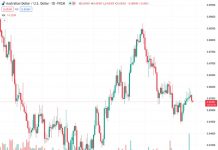
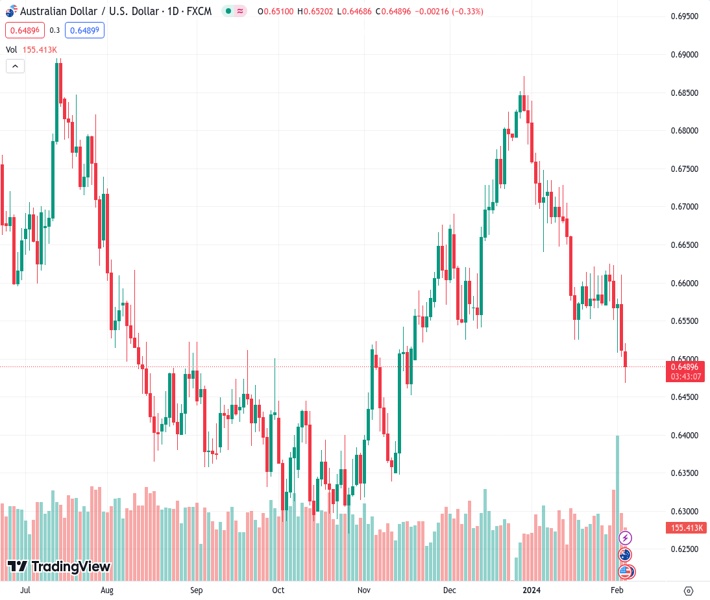
The AUD/USD pair trades at its lowest since last November on Monday, amid broad US Dollar demand. The Australian Dollar (AUD) has fallen against its American rivals in the last five weeks, and started this one by extending its slump. The pair trades below the 0.6500 threshold, and in the long run, it has room to extend the slide.
Valeria Bednarik, Chief Analyst at FXStreet says: “The bearish momentum is evident in the daily chart, as the pair finally slid below its 100 SMA (Simple Moving Average) for the first time since mid-November, and after buyers battled throughout January to defend the area. At the same time, the 20 SMA accelerated its decline above the longer one, reflecting persistent selling interest. Finally, technical indicators suggest bears are willing to keep selling, as per aiming south within negative levels.”
Furthermore, Bednarik notes: “The current price zone seems lacking a relevant level that could provide support. Sellers will be looking for a downward extension towards 0.6450, aiming then to reach the 0.6370/80 area. Given the US Dollar’s broad strength, AUD/USD could extend its slide towards 0.6300/30 following the event. To the upside, the level to watch is the aforementioned daily 100 SMA, currently at around 0.6530. Once above the latter, the recovery could continue towards 0.6600, where sellers are expected to jump back in.”
[/s2If]
Nehcap Trading Strategies
The NEHCAP currently runs the following trading systems for clients. They can be bought and run on your funds.
The system is trading live: LIVE ACCOUNT TRACKING
Contact Us: Contact
The HFT_FIX can be run free for 2 weeks on any broker with a ECN. Apply for a free trial
Join Our Telegram Group