










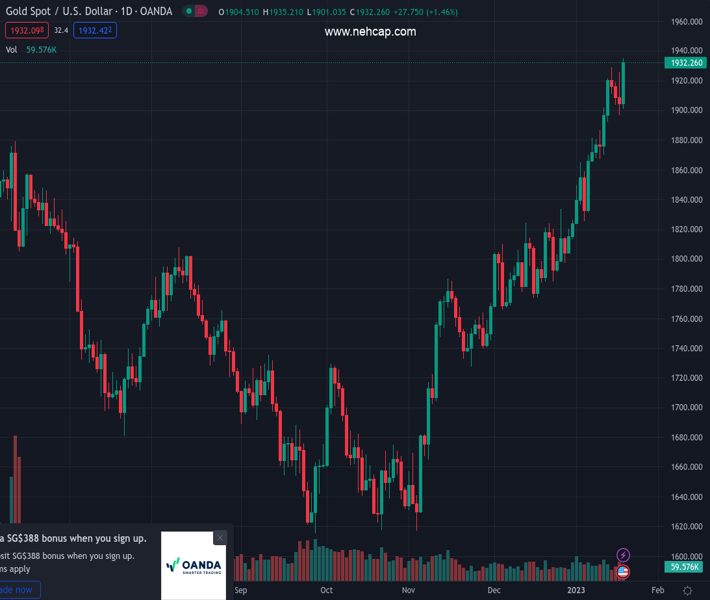
#XAUUSD @ 1,932.14 Gold price is pressured from recent cycle highs and bears eye a correction to the 38.2% Fibo.
…
This is a premium post.
[s2If !current_user_can(access_s2member_level4)]Please register for PREMIUM VERSION HERE to read full post below containing analysis. In case of any error or you think you are not able to read the full post below, please email us at support#nehcap.com [lwa][/s2If] [s2If current_user_can(access_s2member_level4)]
- Gold price is pressured from recent cycle highs and bears eye a correction to the 38.2% Fibo.
- US Dollar needs to get over 102.20 to assist the Gold bears.
Gold price made a strong move to test $1,935 on Thursday, denying the bears a free ride into low-hanging fruit below $1,900 and hitting stops at $1,920 and above. At the time of writing, Gold price is 1.45% higher at around the highs of the day after rallying from a low of $1,901.
A risk-off session on Wall Street did little to support the greenback, with the US dollar index caving to a low of 101.99 in a move that had been telegraphed in prior analysis as follows:
The US Dollar index, DXY, has subsequently been unable to pick itself up from the floor, an area on the charts that was highlighted as a downside target as follows:
”The DXY index, above, shows the US Dollar meeting resistance in a W-formation on the hourly chart. A correction of the bid could be expected to meet the 102.00/20s in the coming sessions as the price reverts to the neckline of the pattern in a 38.2% Fibonacci correction.”
US Dollar index update:
102.20 is now important, guarding a move to the upside.
Meanwhile, there are a number of themes in play following yet more disinflationary economic data on Thursday that has shown that the US economy is losing momentum. Also, the Yen has been rebounding as traders continued to bet the Bank of Japan, BoJ, will shift away from an ultra-loose monetary policy.
Initial jobless claims fell to 190k from an average of 218k over December, suggesting the January labour market report may improve a touch. However, the Philadelphia Federal Reserve’s monthly manufacturing survey showed a notable improvement in the prices paid index, which skidded to 24.5 in January from 36.3 last month, the reading, however, which is a key measure of inflation at the producer level, was the lowest since August 2020. The fourth-quarter earnings outlook also ”looks bleak”, as reported by Reuters: ”Companies are reporting earnings 2.6% above expectations, compared to a long-term average of 4.1% since 1994 and 5.3% for the past four quarters, according to IBES data from Refinitiv.”
On Wednesday, the Federal Reserve’s Beige Book showed that since the previous report, overall economic activity has remained relatively stable and overall, contacts expected little growth in the coming months.
Prior to that release, the Producer Price Index, PPI, and Retail Sales, which showed disinflationary tendencies in the data, reinforced expectations that the Federal Reserve will continue to reduce its tightening pace in upcoming meetings.
It is also worth noting that the US Atlanta Fed GDPNow Q4: 3.5% (prev 4.1%).
Despite the series of deflationary data this week, US Federal Reserve speakers remained hawkish this week. Vice Chair Lael Brainard stated on Thursday that “even with the recent moderation, inflation remains high, and policy will need to be sufficiently restrictive for some time to make sure inflation returns to 2 percent on a sustained basis,” Brainard said.
Earlier in the week, St. Louis Federal Reserve’s President James Bullard said US interest rates have to rise further to ensure that inflationary pressures recede.
”We’re almost into a zone that we could call restrictive – we’re not quite there yet,” Bullard said Wednesday in an online Wall Street Journal interview. Officials want to ensure inflation will come down on a steady path to the 2% target. “We don’t want to waver on that,” he said. “Policy has to stay on the tighter side during 2023” as the disinflationary process unfolds, the Fed hawk added. Bullard has pencilled in a forecast for a rate range of 5.25% to 5.5% by the end of this year.
Nevertheless, Gold price has shown resilience in the face of such hawkishness and has found fresh bids on any pullback taking directional input from the softness in the US Dollar.
A move into the 38.2% Fibonacci could be in order for the Asian session. this meets the prior resistance for mid-January near 41,929. Below there, there will be a risk to the trendline support should the greenback get over 102.20 and stay bid into Friday.
[/s2If]
Join Our Telegram Group