










US Dollar stays relatively resilient against its major rivals on Thursday.
…
This is a premium post.
[s2If !current_user_can(access_s2member_level4)]Please register for PREMIUM VERSION HERE to read full post below containing analysis. In case of any error or you think you are not able to read the full post below, please email us at support#nehcap.com [lwa][/s2If] [s2If current_user_can(access_s2member_level4)]
- US Dollar stays relatively resilient against its major rivals on Thursday.
- EUR/USD technical outlook remains bullish but there is a loss of momentum.
- Nonfarm Payrolls report for March could significantly influence US Dollar’s valuation.
The US Dollar (USD) manages to hold its ground in the second half of the week after having suffered heavy losses against its major rivals earlier. The USD seems to be finding demand as a safe haven as investors grow increasingly concerned about the United States (US) economy tipping into recession. Nonfarm Payrolls (NFP) report for March, which will be released on Friday, could influence the market positioning regarding the US Federal Reserve’s next policy step and impact the USD’s performance.
The US Dollar Index, which gauges the USD’s valuation against a basket of six currencies, holds steady at around 102.00 after having touched its weakest level since early February below 101.50 early Wednesday.
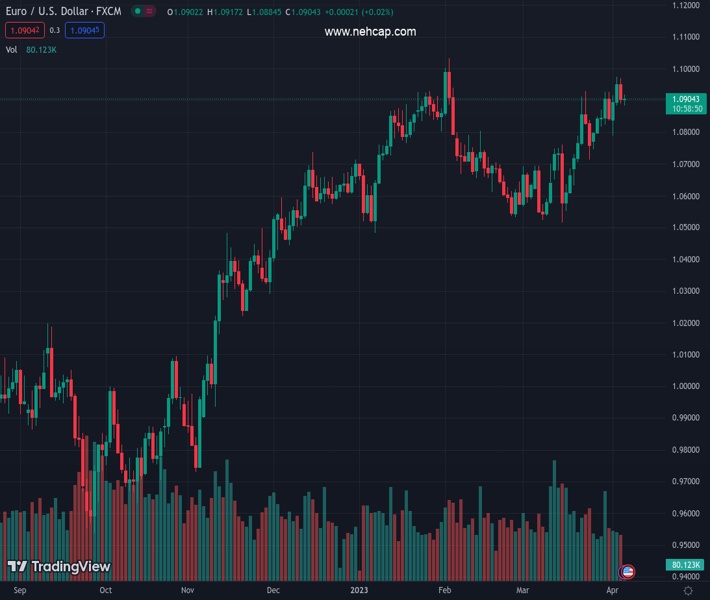
Despite Wednesday’s pullback, EUR/USD’s near-term technical outlook stays bullish with the Relative Strength Index (RSI) on the daily chart holding comfortably above 50. Moreover, the 20-day Simple Moving Average (SMA) continues to pull away from the 50-day SMA following the bullish cross seen earlier in the week.
1.0900 (psychological level, static level) aligns as immediate support for EUR/USD. If the pair falls below that level and starts using it as support, it could extend its downward correction toward 1.0800 (psychological level, 20-day SMA), 1.0740 (50-day SMA) and 1.0680 (100-day SMA).
On the upside, static resistance seems to have formed at 1.0950 ahead of 1.1000 (end-point of the latest uptrend, psychological level) and 1.1035 (multi-month high set in early February).
The US Federal Reserve (Fed) has two mandates: maximum employment and price stability. The Fed uses interest rates as the primary tool to reach its goals but has to find the right balance. If the Fed is concerned about inflation, it tightens its policy by raising the interest rate to increase the cost of borrowing and encourage saving. In that scenario, the US Dollar (USD) is likely to gain value due to decreasing money supply. On the other hand, the Fed could decide to loosen its policy via rate cuts if it’s concerned about a rising unemployment rate due to a slowdown in economic activity. Lower interest rates are likely to lead to a growth in investment and allow companies to hire more people. In that case, the USD is expected to lose value.
The Fed also uses quantitative tightening (QT) or quantitative easing (QE) to adjust the size of its balance sheet and steer the economy in the desired direction. QE refers to the Fed buying assets, such as government bonds, in the open market to spur growth and QT is exactly the opposite. QE is widely seen as a USD-negative central bank policy action and vice versa.
[/s2If]
Join Our Telegram Group